

While it may be sad that in the future we could see more domesticated silver foxes (melanistic American red foxes -Vulpes fulva ) that have escaped from inadequate premises or which have been deliberately released either by animal righters who have no idea about the animal or by some very despicable people hoping that a silver fox -red fox might reproduce and create a far more valuable pellage (politeness dictates that I do not put into words what I think of those employing snares or even still badger-baiting) it is inevitable.

Will the silver fox (again, a North American domesticated fox as Hayley de Ronde of Black Foxes UK keeps having to explain to people) eventually replace the British Red Fox? The thing is that thetrue British Vulpes vulpes died out a good while ago (you would know about this if you ever read my book Red Paper: Canids). Would the situation be similar to that of the British red squirrel (Sciurus vulgaris) with its current 140,000 strong population and the 'threat' grey squirrel (Sciurus carolinensis) which was introduced from North America (2.5 millon population)?

A few home truths first: humans introduced the grey squiorrel mainly as a novelty specimen for estates and menageries. As with other human interferences wirth nature an unnatural evolution took place. What they like to call the "survival of the fittest" -though this is only applied when it is an animal humans want to encourage for some reason.

Another truth is that humans -game keepers, country squires and the wood industry have been trapping, snaring, poisoning and shooting red squirrels for a long time ("shooting a few brace before lunch" -"brace" being a pair- was a little bit of 'fun sport'. From 1977 until DEFRA attempted to stop my being a Partner Against Wldlife Crimes (PAWS) in 2015 (police forces do still consult me) I had to speak to pest controllers, game keepers, estate managers, farmers and estate owners and one after another would refer to the "pests" or "vermin" they had to take care of and one of these was the red squirrel. "Why the squirrels?" I would ask. "Vermin" was the response 99% of the time but the other 1% found it a "fun shoot". I soon became aware that local authorities, DEFRA and the police were turning a blind eye using a few down pat excuses about private property etc. Red squirrels are classed a endangered and even the Young Peoples Trust For the Environment continues the lie of the grey menace
https://ypte.org.uk/factsheets/squirrel-red/territory
In 1945 there was a huge red squirrel population compared to that of the grey as this map from Wildlife Trusts demonstrates https://www.wildlifetrusts.org/saving-species/red-squirrels
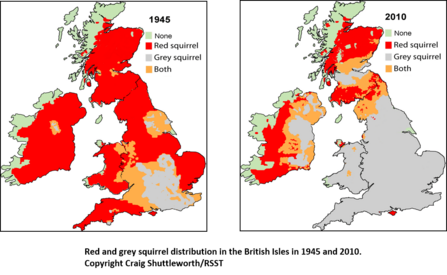
Red and grey squirrels distribution in the British Isles in 1945 and 2010. © Craig Shuttleworth/RSST

So how did the Greys start winning so much territory from the Reds and why? Simple; following the as outlined in The Gazette https://www.thegazette.co.uk/all-notices/content/102333
"The Forestry Commission was founded to restore the nation’s timber reserves in the wake of World War 1. Here's how 100 years of forestry has helped to shape our landscape.
In September 1919, the first Forestry Act, which created the Forestry Commission and recognised the importance of forestry to the UK, came into force.
The beginnings
By the end of World War 1, the UK’s timber supply was much depleted. Britain’s forests had already suffered a steady decline since the Middle Ages, and the additional strain of the war – especially trench warfare – left the nation’s woodlands in a state of disrepair.
From a countryside that was once largely forest, just 5 per cent of tree cover remained, and urgent action was required to address growing concerns.
In 1918, the Acland Committee reported to then prime minister, David Lloyd George, that an organisation with state backing would be the most effective way of restoring and restocking the nation’s forests.
On 1 September 1919, the Forestry Act came in to force, establishing the Forestry Commission and granting it responsibility to look after woods across England, Scotland, Ireland and Wales (Gazette issue 31837).
By Christmas of the same year, the first Forestry Commission trees had been planted at Eggesford in Devon, turning the tide for post-war woodlands, and paving the way for the future of forestry in Britain.
Post-war planting
In the years that followed, the Commission was given the confidence and freedom to focus on acquiring and planting new woodland. Hundreds of thousands of acres were planted, but more turbulent times lay ahead.
As tensions mounted across Europe, the Commission had to draw up felling plans in the event of another war. The Forest of Dean and New Forest were hit hardest, and while scores of trees were felled, the Commission continued to expand; growing its workforce and planting more forests.
The subsequent decades witnessed a dramatic increase in productivity for the Commission, as forests were expanded due to fuel demand for a burgeoning timber trade.
Technologies and mechanical equipment simultaneously improved, alongside a growing awareness of public recreation needs, and the importance of conservation for wildlife and the environment.
Woodland grants schemes, which had existed since the formation of the Commission, evolved and provided different incentives. These included awards for broadleaf planting, and for landowners who considered public access"
Despite all the talk of preserving red squirrel habitata the one thing officials and various organisations keep quiet about is "the squirrel as a pest" -damage to young saplings and mature "timber" -business and estates lose money. Get rid of the squirrels while 'protecting' habitats (until the wood there is needed).
The Grey squirrel is often cited as the "perfect example" of what authorities like to term "invasive species" and these need "eradication" (killing). Odd that the red squirrel population is stabilising and not just due to the mass killings of grey squirrels. Greys have found towns and gardens far better habitats -bird feeders and a very wide selection of foods. Last year the squirrels coming to my garden had young but their nesting area was in the same set of conifers as collared dove and a magpie nest. The magpies moved out so you might think the collared dove nests did not last long. However, the collared doves had a record number of young -the local population has seen an increase in a year and at one point earlier this year some 8-12 could be found on my feeders. The squirrels had good food supplies including my prized lillies (it took 10 years beforte they flowered and last year six were ready to flower but in the space of an early morning all the flowers were eaten) but if you set up a wildlife garden....
So where am I going with all of this? Firstly, large cats from jungle cats (Felis chaus), lynx (Lynx sp.), puma (Puma concolor)and even leopards (Panthera pardus), etc. we have records of living, hunting, breeding and so on since at least the year 1800. There are well established territories where they are known and do not interfere with humans. They do, especially when they have young, kill sheep -opportunistic kills. I have spoken to shepherds in Wales who have flocks of 100+ sheep and "expect to lose a few down crevices, hills or hit my cars" and they know that occasionally they will lose a sheep or two to a cat. Simple answer to this would be to include cat kill alongside dog kill on insurance forms (I know of farmers who showed insurance agents the evidence and were told "Yes. That's a bloody cat kill. We'll call it a dog kill on the claim". Get rid of the pretence because DEFRA, the police, farmers union and literally everyone else (ignore the UK 'big cat' groups) knows the cats are out there.
large cat kills do occur but as a threat to livestock it is on the bottom of the list. Even if we ignore the number of geese, ducks et al living wild in the countryside there are millions of not just rabbits but also all types of deer from the small muntjac to red deer. Even wild boar are taken by cats.
As a side note I should point out that "big cats kill badgers" is a favourite of very ill informed 'big cat' enthusiasts. I have never come across a genuinecase of a large cat killing a badger -badgers are usually vicytims of badger baiters as well as legal and illegal hunting ("I found this dead badger by the roadside" is the favourite cover story of badger baiters who want to sell one to taxidermists and "I passs 3-4 dead on that stretch of road each week" is sureto set alarm bells ringing at full volume).

Large and medium sized cats have been seen stalking, chasing and even killing or even eating rabbits, foxes, deer and so one. The claim that "Big cats are encroaching more into cities and towns" is another incredibly stupid 'big cat' enthusiasts make. Why would a large wild cat species leave the countryside where there is plenty of food, water, cover etc for a town or city to "snatch cats and dogs" and encounter humans which they normally avoid at all costs? Yes, there are sightings on the outskirts of towns and cities but these tend to be regular routes cats travel along. It is possible that an old domestic cat wandering could fall prey to a larger cat but as a rule domestic cats know all the ins and outs in its territory and places where a large cat cannot get through.
Again, the 'big cat' enthusiasts talk about puma and panthers stalking back gardens looking for food. In a number of cases of large cats being seen in gardens it is in the countryside and they pay no attention to anything other than where they are headed. I once had two phone calls in one morning from Gloucestershire and both women perfectly described a black leopard walking through their gardens. I got the first address and when I was told the second address I asked whether the caller knew a Mrs K---? Oh, yes. That was her neighbour and she was going to go chat to her but not say too much sas the cat had gone through the hedge into her garden she felt foolish mentioning a large cat to her in a conversation. Her neighbour had seen the cat come through the hedgerows and both times given tallied. Both used the same phrase "it was just walking through paying no attention to me".
There have been faked stories of large cats in the UK attacking people. Fake. Rather like the fake stories of foxes entering town homes via french windows and bypassing the householders watching TV (in front of the open windows) as well as two "feisty" dogs, going upstairs, biting a baby in a cot and then retracing its route out of the house. Or foxes caught on CCTV killing a pet cat -challenged the person claiming this cannot produce the evidence from the CCTV camera and vanishes.
People have reasons for faking stories. Feral cats murdering vast swathes of British wildlife -birds, frogs and so on. Yet, as was noted in 2000 (20 years ago) feralcats were not doing this; people putting out food for strays or hedgehogs and even near the feral cat colonies meant that these cats were not relentlessly hunting and killing all the pretty birdies. Local authorities and othergroupslike this excuse because they can then kill cats as pests for various reasons.

Locally, there was a flock of 25 pigeons, ex racers dumped by someone. The number never rose above35 individuals as there were three hawks and a buzzard active in the area and I recorded the kills in my records. One day the pigeons were gone which was annoying as there were two ringed, stray racers that I was trying to catch to return to the owners. I found out that the City Council was involved. I was told by someone at Bristol City Council that the birds had been reported as "pests" so they were gotten rid of. When I put together a formal complaint aboutthis Bristol City Council suddenly denied everything.

The one reason that the Red Paper: Felids will never see print is the record of this country when it comes to labelling everything an "invasive species" and on a list to kill (unlike 'big cat' enthusiasts I have the affidavits to prove large cats are trapped, killed and disposed of in the UK by DEFRA). A new native population of silver foxes would be added to that list. We know that porcupines that had lived wild in the UK for decades were killed due to this. Raccoon dogs are killed because of this. Raccoons -you name it and DEFRA and its "invasive species" agenda (I once had a DEFRA man tell me "We don't necessarily like this but we have to follow orders"...I say nothing) allows it to be killed.

Because it would be a technical paper Red Paper: Felids would not just look at how the various cats got here but also territories established and so on. That would give authorities all the information needed to move in an exterminate the animals and those seriously involved in thiswork know the names of at least five hunters who have been after that information for years (some have made preliminary deals with TV and newspapers that are potentially very rewarding financially -I know because I was also offered the money).

Wolverine (largest member of the mustelid family) have also been in the UK since at least the 1800s and there is a suspicion that some have been killed -one killed by a car in Scotland resulted in its carcass beingremoved and a cover up ensuing and two wlidlife rangers who found the body were told to be quiet.
If we just say that these various animals have been in the UK since 1800 with all of the evidence of breeding and so on why has British wildlife not been devastated or wiped out?
Wolves in the UK? I covered the subject of wolves in The Red Paper along with jackals and coyotes in the UK. Coyotes lasted in SE England (a small population) from the 1800s to at least 1940s. Why they suddenly became extinct may have been due to hunting since food sources were plentiful. Wolves are not the savage, wild man killers of the movies and yet they could survive given the number of deer and rabbits in the UK without any human conflict occurring -again; insurance coverage for livestock lost to a wolf could go under a dog attack claim.

Despite all the TV programmes and the information they put out (while fulfilling the wildlife "snuff clips" quota) people still believe false claims about foxes and some cannot even clearly identify a fox 6 feey away from them. We need to continue educating on foxes whether silver foxes or red foxes as well as wolves and various wild cat species. In my career I can tell you that as a naturalist you make no money (you tend to lose a lot!) and also those involved in or associated with hunting, snaring etc will threaten you, make up lies about you but generally threatening is what they prefer. An old naturalist once told me that that taking up wildlife projects would not just be about facing apathy or even fighting the odd battle but I would be entering into an ongoing war that at times seems unwinable. Ask any naturalist about the problems.
And so, the education of the public goes on while the safety of the various species at risk in the UK has to be safeguarded. The one thing I have learntis that the biggest threat out there are humans.


