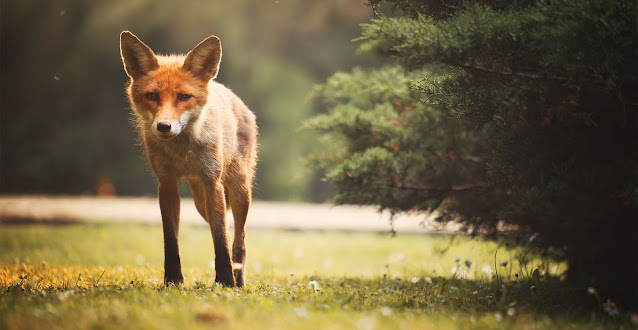
Vulpes vulpes crucigeria
__________________________
I believe that we are in some cases vastly over estimating the UK fox population and not realising this could lead to future problems.
After the importation of foxes into England began it did not take long for mange to rear its ugly head. Firstly we have to be aware that these importations possibly began in the late 1600s which was further back than I initially assumed as by the late 1570s the scarcity of foxes was noted. Remember that foxes were looked down on as beasts of the chace until wolves, boar and all the “better” beasties were killed off. Foxes were not, despite the pro hunt lie (see A Very Brief History of Fox Hunting in England), the enemy of chicken farmers “since the stone age” (when there were no chickens kept). Foxes were generally hunted during winter for their fur as well as an extra source of meat –still common in Europe in the 1800s.
Leadenhall and other markets both big and small were supplying hunt buyers directly or, far more common, the representative of the hunt since gentlemen did not deal with tradesmen.
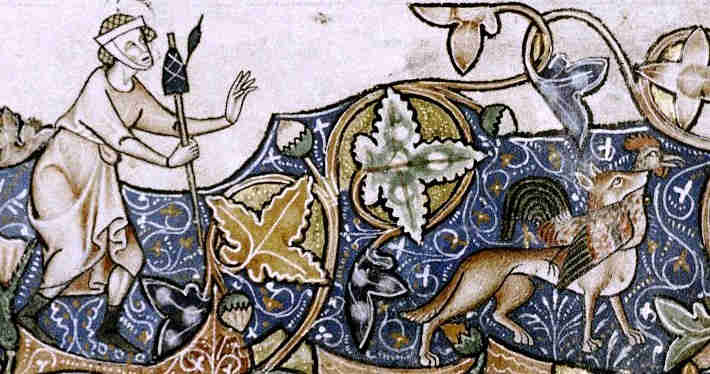

Medieval painting of the farmer, the fox and the Chicken -losing fowl to foxes in 2021 is simply bad management
__________________________
Importing exotic animals –mammals, birds, etc- picked up in the 17th century and by the 18th century it was big business that became huge during the 19th century. With exotics the big name dealers such as Jamrach, Cross et al maintained clean conditions if somewhat insecure facilities. A gentleman was not going to buy a new specimen for their menagerie that looked in poor condition. With foxes dealers were somewhat more bláse; buy the foxes, do the deal and sell them then ship them out by cart to the buyer. One might think a certain dealer in foxes who was displaying them for sale was an idiot for allowing for to escape but one has to recall that Jamrach had leopards escape from his premises.
MFHs (Masters of the Fox Hounds) along with other ‘sportsmen’, according to their own writings, were miserly cheapskates who complained about the phenomenal financial burden placed upon them to “simply enjoy our sporting fun”. The hunting tax, the cost of stabling horses and hounds –if a farthing were spent it was drawing the life blood! Therefore if a dealer was somewhat cheaper than someone at Leadenhall that was a saving –though they expected good quality animals. Several writers note that the dealers tended to be Londoners with no idea about foxes who just wanted to make money and kept their “produce” in poor conditions where hygene was a word unknown to them.


Mange on a fox from Downend, Bristol 2021
________________________
Foxes checked and purchased might look good but until they arrived at their destination to be turned out in the country they would be hunted in there was no knowing if they might be infected with mange. Cramped, dirty cages used over and over to transport foxes probably never got thoroughly cleaned out as you sold foxes then got more to sell and so on and so forth.
It was claimed that until the importations from Europe mange was unknown in England. This appears to be true since mange first gets mentioned in the 1800s. The suggestion has always been that this was down to foxes imported from Europe but –and it is something I have not yet delved into- it does not appear to have been rife there. Lack of hygene seems to be the cause and that started at the trapping, selling, shipping and then importing and selling on stages. Some MFHs even sent men to Europe to trap foxes to cut costs but this was not successful and one assumes the locals were not too keen on this theft of possible income.
However, the ‘sportsmen’ blamed everyone but themselves because, as the persons instigating this trapping and importing for their ‘sport’ they could quite easily have put pressure on dealers with the one with the best hygene and conditioned foxes getting more trade. You might think but this was about getting foxes to hunt and kill and for as little financial outlay as possible. To cut costs even further hunts had their own Fox yards or stables in which they bred their own foxes and there are clear instructions on how these and fox hound kennels should be maintained and kept hygienic.


(c)2021 respective copyright owner
______________________________
We know that in the 1800s there was a formula for treating mange in hounds and this seemed to work. It was thought that there were two kinds of mange whereas one of the ‘types’ was infection caused by mange. The causes of mange there were many discussions and much port no doubt spilt over in arguments. The lack of fresh air, the wrong foods and so on.
There was absolutely no question of treating a fox with mange. Well, there was a ‘treatment’ and here I quote: “Do not suffer them to live. Kill them –cubs and all!” That was no exaggeration. This is how it worked; a fox was seen with the first signs of mange –just a little hair missing- and it’s den was then checked (remember that MFHs maintained fox dens and coverts and they were all plotted out on maps) and the fox was shot (this was often done by the ‘sportsman’ as they considered it below the dignity of the game keeper, etc). If there were cubs, even if they looked perfectly healthy they were killed. If any other fox had visited the den –dog fox or vixen- they met the same fate as did their cubs or others in the area as this was “far more preferable” to mange sweeping a territory and devastating the ‘sport’ –the actual teary writings of one ‘sportsmen’ over having to kill cubs and all was almost emotional until the line “Oh, how our sport will suffer!”
Mange sweeping MFH countries was quite common it seems back in the 1800s at the height of fox importations yet I can find no references to exotic animals imported that developed mange. The concern was that any infected fox would escape into a neighbouring country (hunt territory) and devastate the population there. Therefore, with each wave of mange came the “burnt earth” policy of killing every fox devastating as it was for the ‘sport’ and the coffers when buying in new stock. Sensibly dens that had housed infected foxes were demolished.
The continuing reporting on the scarcity of foxes throughout the 1800s spilled over into the 1900s when foxes were “stolen” from Irish MFHs to provide fresh foxes for English MFHs –and questions were raised in Parliament. This stealing –including people stealing foxes from one English MFH to supply another MFH (“it is probably best to never ask your supplier from whence the bagged foxes came”).


19th century fox illo digitally coloured
_______________________________
It means that even the importing of foxes was not keeping the population stable. Remember that during “cubbing” the hounds were “bloodied” to know their prey and had cubs thrown out to them to chase and kill –sometimes an entire litter of 5-7 cubs. If the vixen was chased and killed it was a bit extra ‘sport’. Braces ( a “brace” being a pair of dog and vixen) were killed and some hunts killed two or more pairs. Even noticeably pregnant vixens were chased and killed and one cut open “revealed seven cubs”.
Normal persons would see the problem here. You kill the cubs that later in the year provide your chase. You kill breeding pairs who have the cubs that provide your chase. You kill a clearly visible vixen because, basically, Nothing better turned out that day. Then, come “the chase season” and you note “scarcely a fox seen” or “poor showing this season with no sight of a fox” and why might that be…? An MFH reading this paragraph would probably now develop a severe migraine trying to fathom the answer to that question.
But then we had the great lie that, during World War I, when all the gamekeepers, sportsmen and land owners were off fighting for King and Country, the fox population was unchecked and there was a population boom ready for the post war years. A lie is presented with “the fox population was unchecked” because it is on the record that farmers and others were still killing foxes and finding dens killed cubs. The war ended and it was time for the ‘sportsman’ to take part in some decent fox killing because, obviously, what had gone on in the trenches was “just war”.
This is when we see the other part of the fox population boom lie show itself; the Great Scarcity of 1923 when fox numbers were so low that there were concerns that the ‘sport’ might not continue. However, “numbers picked up” we are told. We know that there had been mange outbreaks and the usual “kill every fox” policy was adopted so that wiped out a great many animals that created the Great scarcity. Foxes were still being imported into the UK so over population of foxes after the war is quite untrue.


"Animal loving Britain" has tried for a long time to cover up its history of fox fur farming -a subject being studied currently by Hayley de Ronde of the BCHS.
_______________________________
We add to the hunts the snarers who killed to get fox fur and these people killed a great many and their activities during WW I did not attract the attentions of game-keepers as it did before –killing the ‘sport’ animal was a most horrendous act after all and not sporting. Mange during 1914-1918 we don’t know too much about and it takes reading many of the books to just grasp what was going on between the years 1820-1900. One assumes that less traffic meant far less road kill.
We have the question; “if foxes were so plentiful why did MFHs release wolves, jackals and coyotes to hunt –simply better ‘sport’?
But post World War Two the ‘sport’ continued –as did snaring and shooting of foxes and the “great days” of hunting were seen as gone (as it was stated in the early 1900s) but “a chap must have his fun!”. Unfortunately for the MFHs there were now stronger regulations and restrictions, especially since the 1920s to prevent rabies. There were other threats to foxes.
As I noted in The Red Paper according to a Ministry of Agriculture, Fisheries and Food (MAFF –the predecessor to DEFRA) report in 2000: the fox population in 1995 was “guestimated” at 240,000 and some 33,000 were considered urban foxes. It is stated that shooting was the favoured method of control in the countryside where some of the figures given are highly contentious. Snaring was thought to account for 36,000 foxes each year. Some 50,000 cubs were thought to be dug out of dens using terriers and 10,000 were killed by lurcher dogs and 15,000 by fox hunts. MAFF told me when I queried some of the figures that “It’s the best figure we came up with” (Red Paper pp 28-29).
I decided to total up the figures for 2000:
Killed on roads 100,000
Shot 80,000
Snared 36,000
Dug out and killed 50,000
Killed by dogs 10,000
Fox hunts 15,000
Total 291,000
In 1965 Brian Vesey-Fitzgerald tried to find out how many foxes were being killed (and he was decidedly not anti hunting) and he got plenty of cooperation from fox hunts.
Wales
1947 10,000
1948 10,000
1949 7,978
1950 7,828
1951 7,229
1952 6,403
1953 5,105
1954 6,307
1955 8,620
1956 6,939
1957 6,314
1958 7,143
1959 6,033
1960 8,361
1961 9,140
1962 8,481
The 16 year total amounts to 120,000
Scotland
1948 9,207
1949 7,114
1950 7,264
1951 7,183
1952 7,236
1953 8,438
1954 9,318
1955 11,145
1956 12,084
1957 10,006
1958 10,380
1959 8,259
1960 7,743
1961 9,756
1962 10,984
15 years total amounts to 136,000
It seems that Vesey-Fitzgerald found English fox hunts far from cooperative
England
1959 4,407
1960 4,548
1961 4,375
1962 3,931
Four year total of 17,261
It was noted how secretive the MFHs were regarding kills so Vesey-Fitzgerald asked the Master of the Fox Hound Association J. E. S. Chamberlayne and his estimated was 12,000 per year by recognised hunts. The unrecognised (non MFHA) hunts would increase the number to 14,000 per year which Vesey-Fitzgerald estimated would mean 40,000 foxes killed each year in England. For a 16 year period in the UK that would be a total of 640,000 foxes killed by hunts alone.


Here is another “guestimated” figure: from November, 1959 to March, 1960, it is believed that 1,300 foxes died in England from a virulent form of sarcoptic mange. The truth was far worse as it was later established that indirect poisoning by chlorinated hydrocarbon insecticides was responsible. Birds had ingested the “dressed” corn and died and foxes had eaten the dead birds (echoes of the current secondary rodenticide poisoning of foxes). Absolutely no one appeared to be concerned at the situation and no one took any action –“just foxes”.
I believe that some of the fox hunt figures probably received some “touching up” to make it look like fox hunting was necessary but fox numbers would have been bulked up by cubs killed and there is no indication that any of the old ways had been changed.
If you look at these figures it does make your head spin somewhat. Just how did foxes continue to exist? Well, we have the fox hunts maintaining their artificial coverts and breeding of foxes and this continues today as new concrete culverts to house foxes in are discovered.
When you take a look at 2018 and the 63,000 foxes that vanished the number seems quite low. Firstly, the foxes did not “vanished” –they died from disease, hunting, shooting, snaring, poisoning and so on. Also, the figure of 63,000 is a “guestimate” because no one knows the exact number of foxes and this is where I have my problem with the promoters of such figures.


(c)2021 Chris Hill -Bristol foxes on a roof
_______________________________________
There has been almost a craze to “guestimate” how many wildlife species are killed by domestic cats each year. A figure of “millions” is quoted all over the world and promoted by groups and people who really dislike cats. The experts look at how many cats might live in an area and then they expand the total figure for a city or town and eventually we have a vast over “guestimate” of how many cats are in the UK.
I have trail cameras and regularly get three to four regular domestic cats in my garden and sometimes 4-5 on walk through. I know there have been three rats killed and a few mice and my neighbour tells me of the failed attempts of their cat to catch wildlife. I have asked other people who have kept cats and they tell the same story. Not every house has a cat and therefore “millions” of species are not being killed each year. Pet cats are too well fed and, incidentally, despite all the cats there are still mice in my garden.
With foxes the experts go by figures they have seen and extrapolate from that. Before all the local foxes died off I was speaking to people I knew who kept their feeding foxes a secret. Some did not know others who had fed the foxes and in the end I was able to estimate that in the local small area there were over twelve foxes. Something did not make sense and so I asked the feeders various questions about “their” foxes. One had a bit of ear missing. One had a long straight tail…it went on and on and in the end I found out that there were three foxes in the area and no sooner had I logged them than they were dead.
Some people do get a number of foxes visit and some of these are transitory. One feeder had five visit her but within a couple of months was left with just one –cars had taken their toll. Three foxes spotted in one street were dead within the month. Five foxes on an allotment –three died suddenly. Further along the road another died. Not far from that another. It is Tuesday 16th November, 2021 and in the week so far three RTA foxes (these are only the ones I have reported to me) plus a couple of other dead foxes. On fox groups I note more recent fox deaths. If I added all of these foxes together and had no idea they died, or for that matter how many are dying daily, then I based an overall population figure on that –wow! We have so many foxes.
In its first year a fox is called a Cub. In its second year it is an Adult. From the third year on it is Old –there are exceptions of foxes living 10 years but there are so many threats excluding disease and I would be afraid to look at an accurate total of RTA foxes for one 24 hour period.
Over the years I have spoken to farmers and others who say that seeing a fox is rare or even that foxes haven’t been spotted for a year or two. That is odd because once a territory is left vacant another fox will move in. In the 1994/1995 mange outbreak in Bristol we were left with an estimated 6% of the fox population. Bristol City Council officially adopted the no fox control policy after studies showed that one fox out and another takes its place.
Iceland has now seen, via scientific work, that killing foxes serves no point and is harmful to the ecosystem.


The fact is that foxes are a good indicator of the ecosystem and we have learnt a lot from their behaviour and, sadly, deaths. That birds of prey, pet cats, badgers and hedgehogs are all dying from secondary rodenticide poisoning or poisons used by the public is common knowledge amongst naturalists and even official organisations. We know foxes are dying the same way. This indicates that environmental policies and controls are failing. It is impossible to estimate the national fox population because so many die daily and with people reporting not seeing foxes any more in some town areas this raises concerns.
Feeders and fox watchers who are treating foxes for mange and other injuries has meant that far more survive these days. If we add to this the number of rescued cubs and adult foxes going through rescues the a population is being maintained by the release of these foxes in so called “safe areas” where there is no hunting but even if I push up the estimate of how many are released each year to around 2,000 I also know that around that number probably die each month. Also the releases and escapes from UK fur farms may have contributed to the fox population at the time but even that would have been a temporary “fix” to fox numbers.
To put it simply we have no idea of how many foxes are in the UK because to know that we would need to count them. We do not know how many foxes die each week nationally but it is high. Even an AI program can only so useful because, as my late colleague Franklyn Davin-Wilson pointed out (as a computer expert): “Bad data input =BDO –Bad Data Output” which means “guestimating” can only be achieved by looking at various things such as projected number of foxes shot each week, foxes we know are snared, poisoned and killed by hunts and then look at what locals report such as fox deaths, former well established leashes (group of foxes) vanishing or down from 7 in number to 2 and many other factors.


(c)2021 Fiona Lacey -taken in 2020
______________________________________
What you realise is that there is no such thing as a healthy fox population and as it has always done the numbers rise then fall dramatically. The 1965 figures showed how low the fox population was dipping because they are nowhere near the established totals killed during the Golden Age of Hunting in the 19th century. If we look at the 2000 then any sensible person can only deduce that such losses are not sustainable.
As I noted earlier, Iceland is one of a number of countries were fox eradication has stopped. Killing off foxes is bad for the ecosystem and the pretence of having to kill ‘vermin’ (which DEFRA itself points out has never been an official term or classification but purely a pro fox hunt one) is so old and worn out. Foxes can draw in money because wildlife is big business and you own land and can attract townies wanting to see real “wild foxes” you can turn a pretty penny.
The true state of the UK fox population only truly struck me when I was looking at old hunt books and mange as well as foxes numbers killed. Add to all of this the other factors, all known and recorded in books and journals of the time so easily checkable, I think the continued killing of foxes should be stopped. Businesses calling in shooters to trap and kill (based on advice coming from Natural England which shows it really has no real knowledge of foxes) at schools, supermarkets or other businesses should be legally prohibited. Humane trapping and release is the way to go and for pest control humane trapping and release is far more likely to attract business and less protest.
The fox is a good rat pest controller so why kill off the free natural pest control unless it is about money making.